My Mom Was A Homesteader Before It Was Cool

I grew up in the country raised by a pretty badass mom. My mom was a registered nurse for 54 years. She worked at a small hospital located on the top of a hill in an equally small town. The offices and patient rooms in the hospital had a stunning view of the lake below. She mostly worked the 7am  to 3pm shift and was home when I returned from school. Sometimes she would cover the 3pm to 11pm shift for a fellow nurse but not often. She was perfectly suited for that profession. She was amazing. But what really made her enormously amazing was the mother she was (and still is) while I was growing up. In between all the days and hours that she worked as a nurse she was a gardening, cooking, baking, canning, and sewing queen. And the royal term of “queen” is a bit of an understatement. 
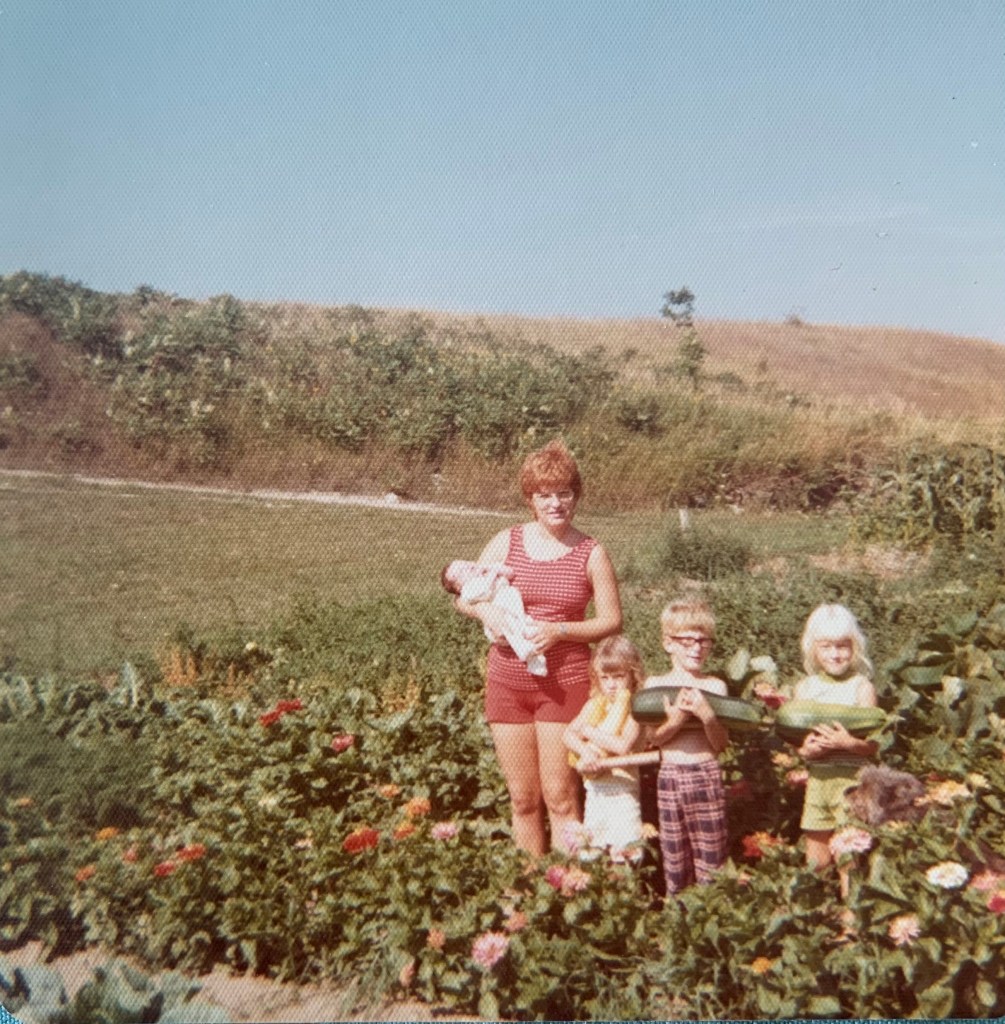
My mother and her garden.

Gardening was a big part of my mom’s life. And it was a huge garden. It had a hedge of raspberry bushes followed by rows and rows of vegetables. We had beets, beans, radishes, squash, zucchini, cucumbers, pumpkins, tomatoes, carrots and more. Springtime would arrive and my mother would gather her basket with a collection of seed packets. Passing me a packet of pumpkins seeds, she’d patiently show me how to space and cover the seeds. I remember eating dirt covered carrots from the garden on sunny afternoons. With the promise of a quarter or two, I would weed rows of veggies after my mother carefully pointed out the emerging plants and how to spot the weeds. Reaching through the prickly raspberry bushes, I’d pick cartons filled to the brim with the red “button” berries. In bare feet, I’d walk between the rows and rows of plants with my feet sinking in the sun-warmed dirt with each step. My mother’s garden was a glorious place. My mother’s magnificent garden.
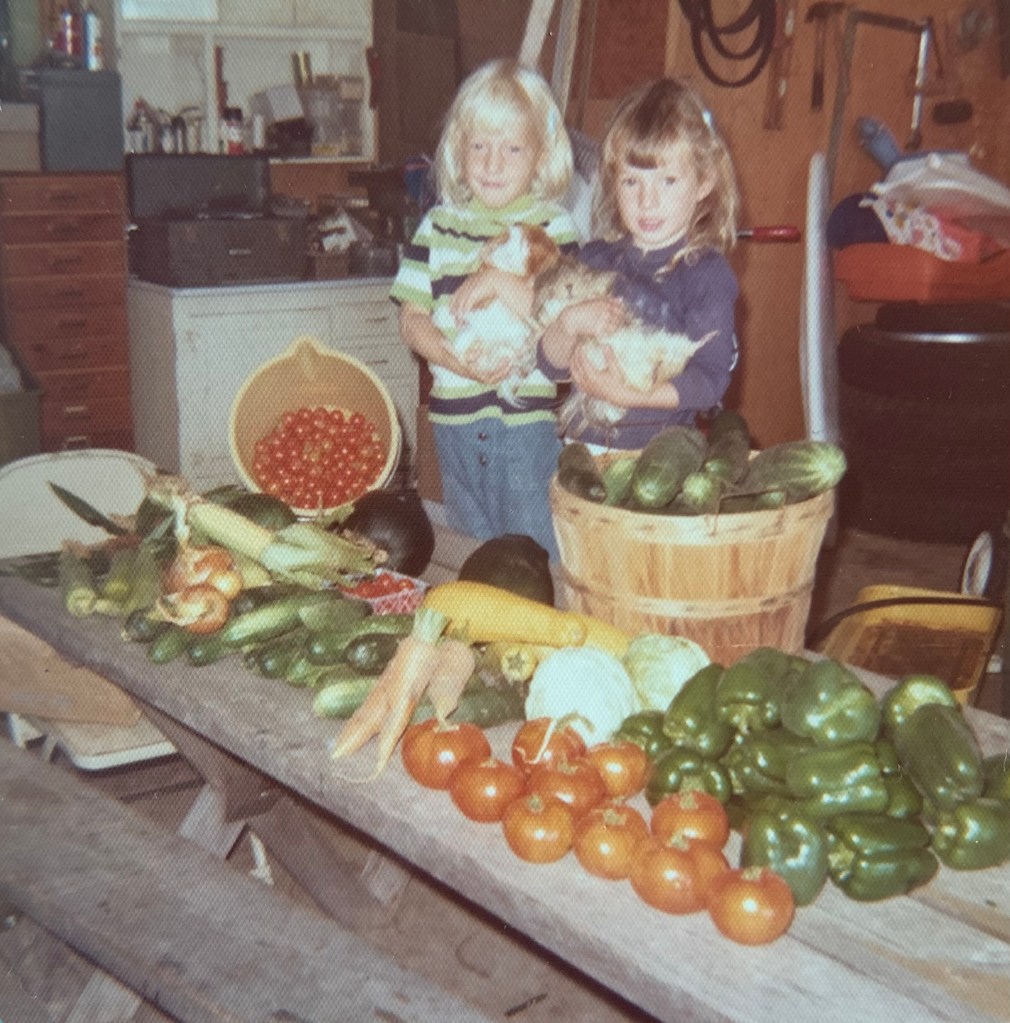
The bounty and bunnies.
My mother with my youngest sister and our dog named “Puppy”.

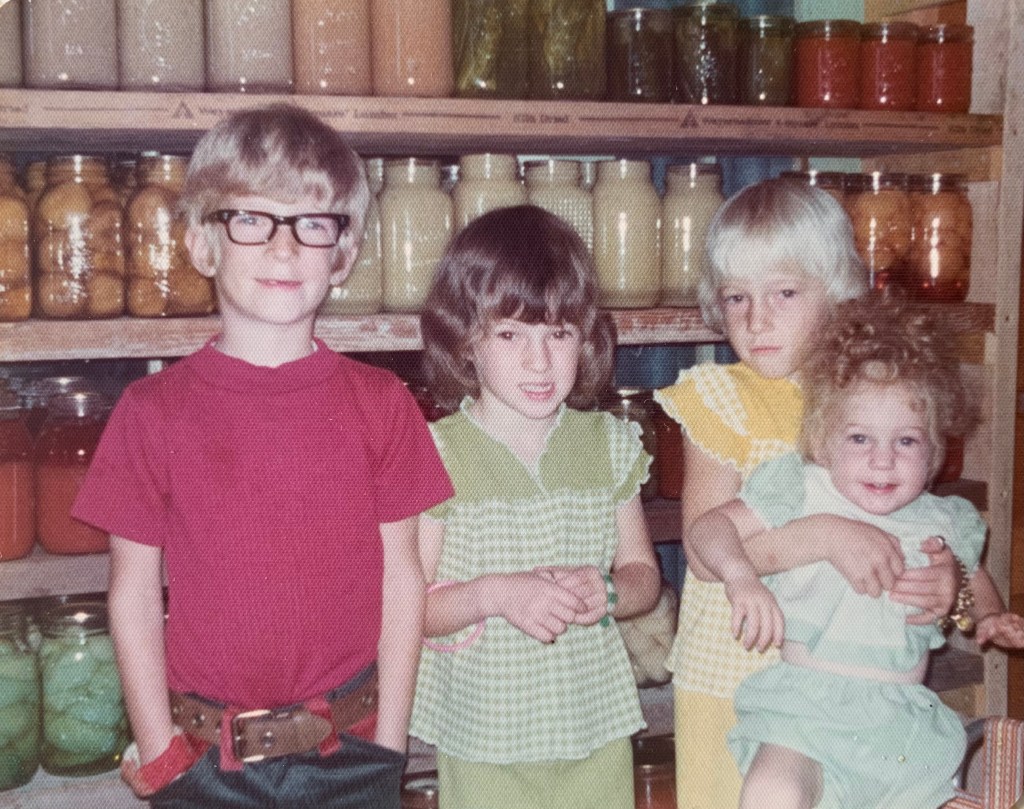
Many of the vegetables from her garden found their way preserved inside jars. The jars filled shelves situated in our garage. There were jars of golden peaches. Jars of savory tomato sauce. Jars of “dill”icious pickles. Jars of tangy applesauce. It was a rainbow of glass contained fruits and vegetables perfectly lined up. My mother was a canning queen. The kitchen would be whistling and ticking as the pressure cooker was at work. The table would be overtaken with jars, lids, pots, funnels, dish towels and a jar lifter. Shifting from table to stovetop with moments of steam billowing around her, my mother would preserve some of the delicious bits from her garden. 
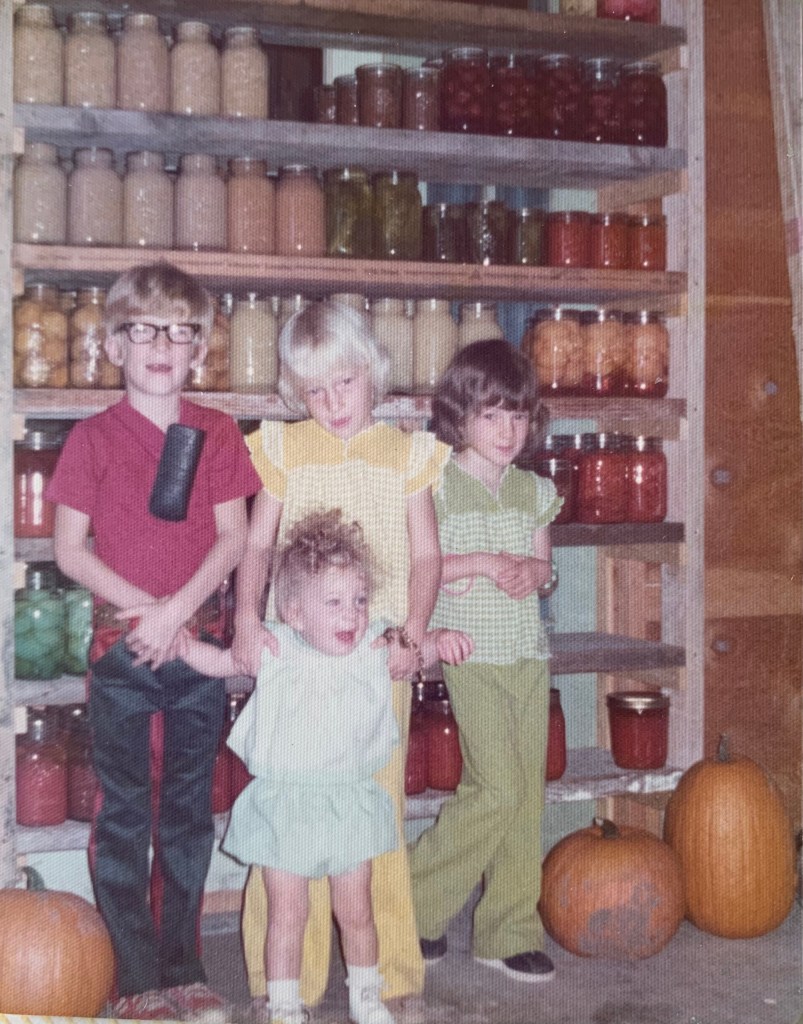
The “rainbow” jars.

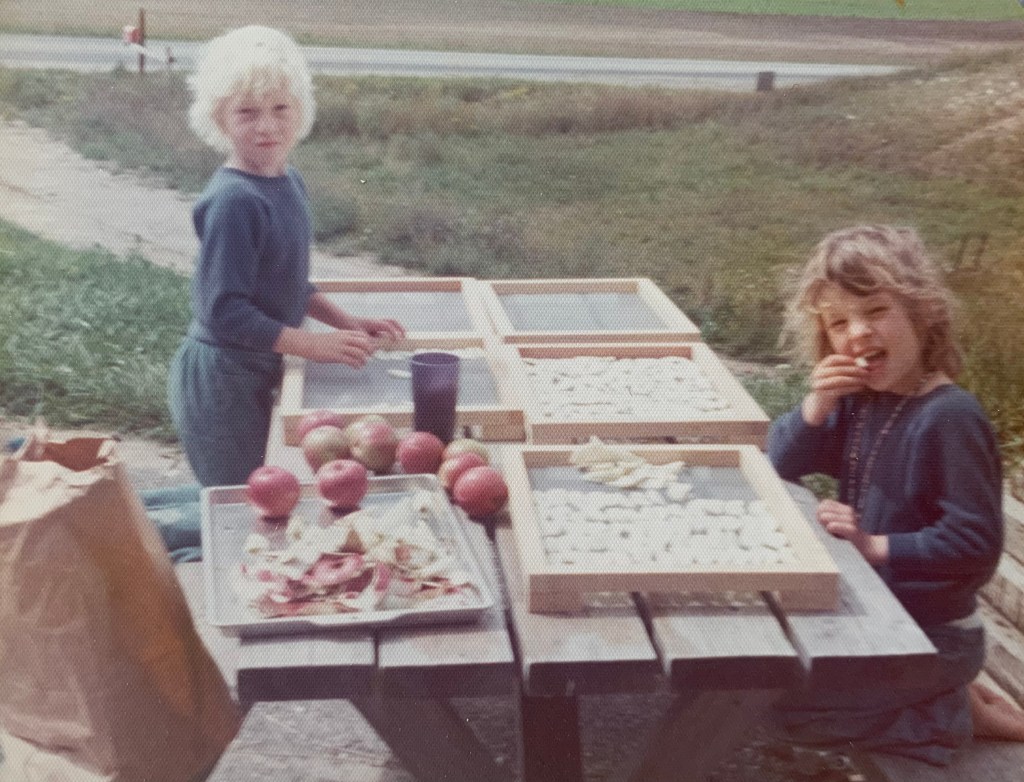
The preservation went beyond the jars too. She made sauerkraut in a large earthenware crock pot. The heads of cabbage would glide across the kraut cutter as my mother shredded a pile of cabbage heads. The shredded cabbage would be salted and pounded with the kraut stomper. Again and again. Then finally sealed beneath the pressure of a wooden lid. Besides preservation within a crock pot, she would preserve slices of apples on top of screened frames. Sitting outside under the afternoon’s glowing orb, she would slice the apples and my siblings and I would place them on the screens. Sweet, crunchy pieces of apples filling every possible surface of the screens. Meals at our home were literally the fruits (and veggies) of my mother’s labor. 
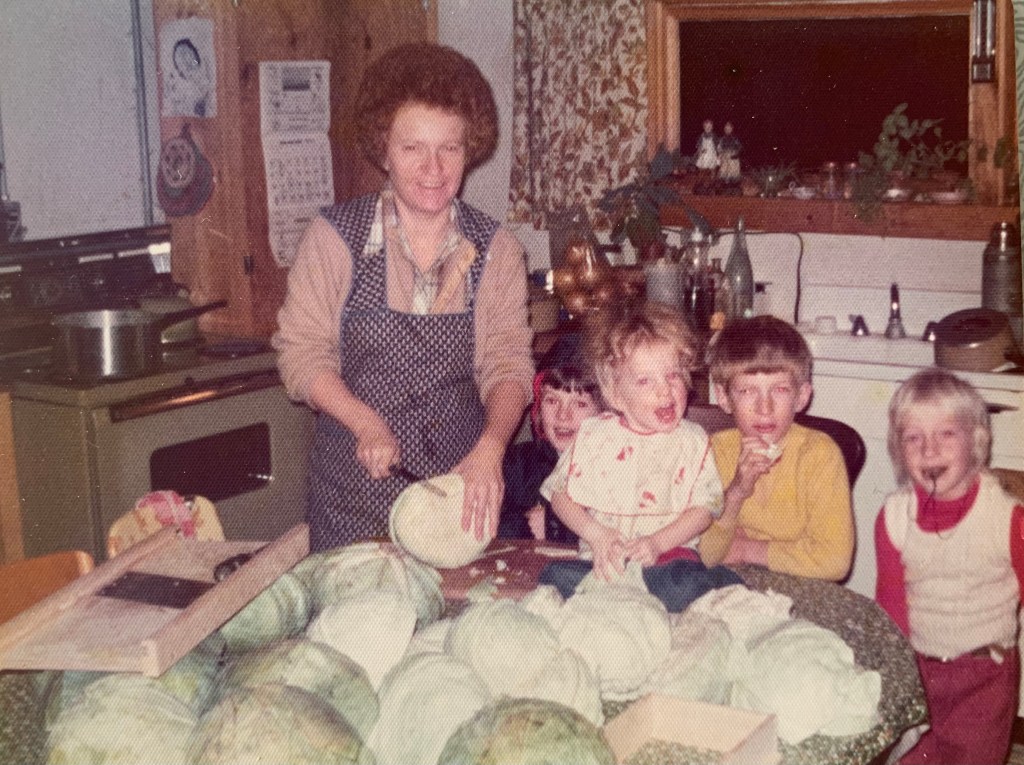
Mother making sauerkraut with her dedicated fan club.

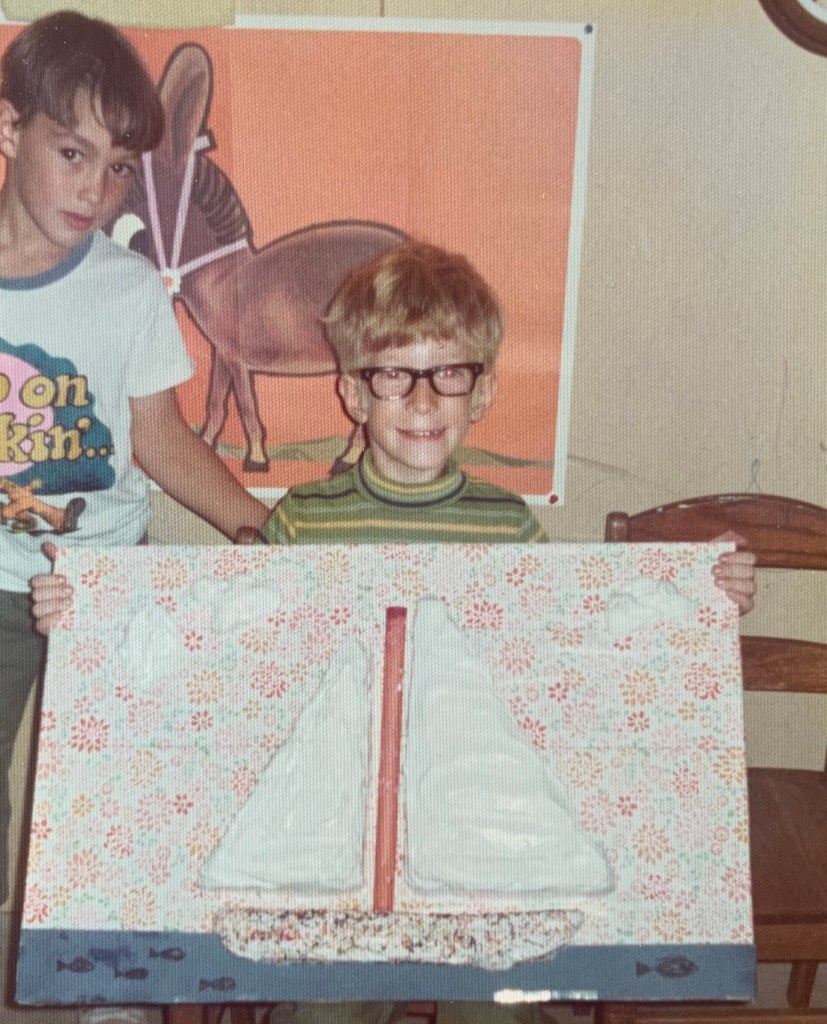
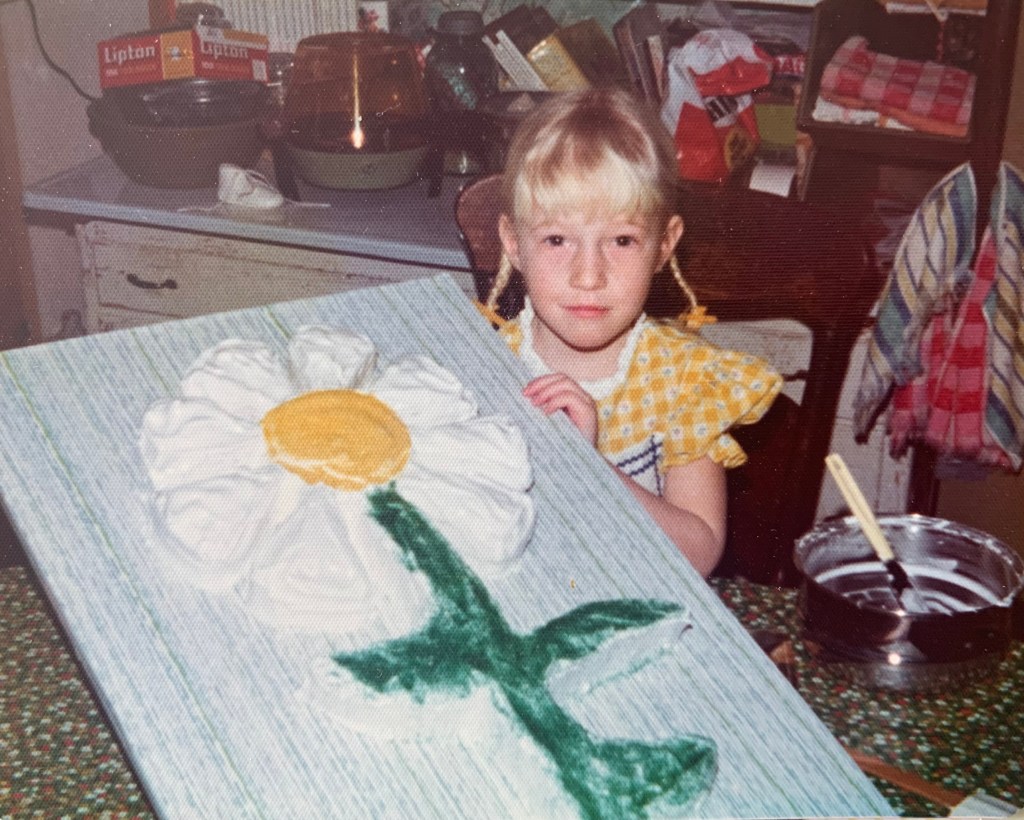
The kitchen wasn’t only for garden preservation. My mother was a baker. The most memorable baking from her kitchen was the birthday cakes. She never ordered a cake from a bakery or bought a cake at a store. She made our birthday cakes. These cakes were not simple round, layered cakes either. A butterfly. A sailboat. A flower. A snowman. Each one embellished with candies perfectly placed on a soft canvas of frosting. Keep in mind, my mother had four children. I can remember on my birthdays I would be beaming as a cake was placed in front of me. Candles lit. Wishes made. One of the greatest childhood gifts from my mother on my birthday – the cake. 

My “Alice In Wonderland” cake for my 4th birthday.
A boat cake for my brother.
A butterfly for my sister.
A snowman for my April birthday sister.
A sailboat cake for my brother.
A Daisy cake for me.

One of my cherished tops as a child was a sleeveless smock with lace along the shoulders and red apple buttons. My mother made it. And it wasn’t the only garment she made for me. She sewed a robe for me with quilted, silky pink fabric. I felt like a princess every time I wore it. My closets and drawers were filled with items sewn by her. She sewed for my brother. She sewed for my sisters. As we slept, she would sew. I would wake up to an outfit hanging up waiting to be finished. Or to a one that was finished and waiting to be worn. She sewed our Halloween costumes. A clown suit for my brother made with boldly striped flannel fabric. An angel costume for my sister with sleeves that were edged with silver Christmas tree garland. A witch one for me with silky black fabric that flowed with every movement. The hum of a sewing machine was a familiar sound in our home. 
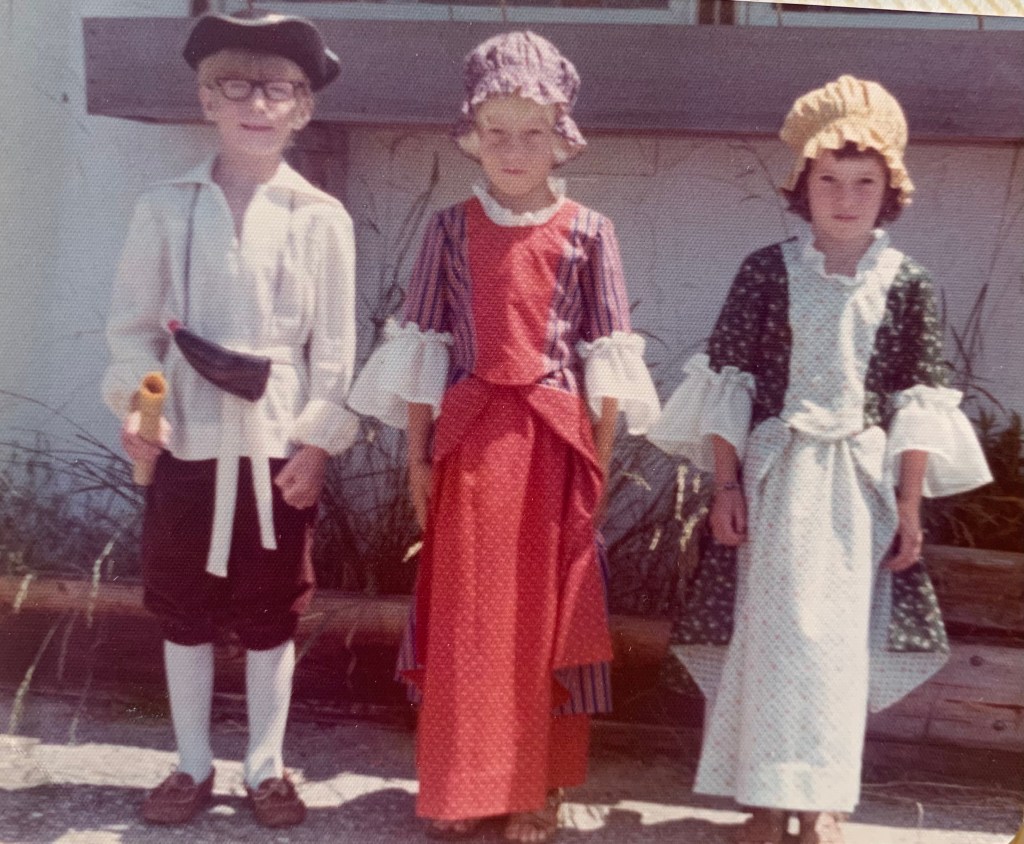
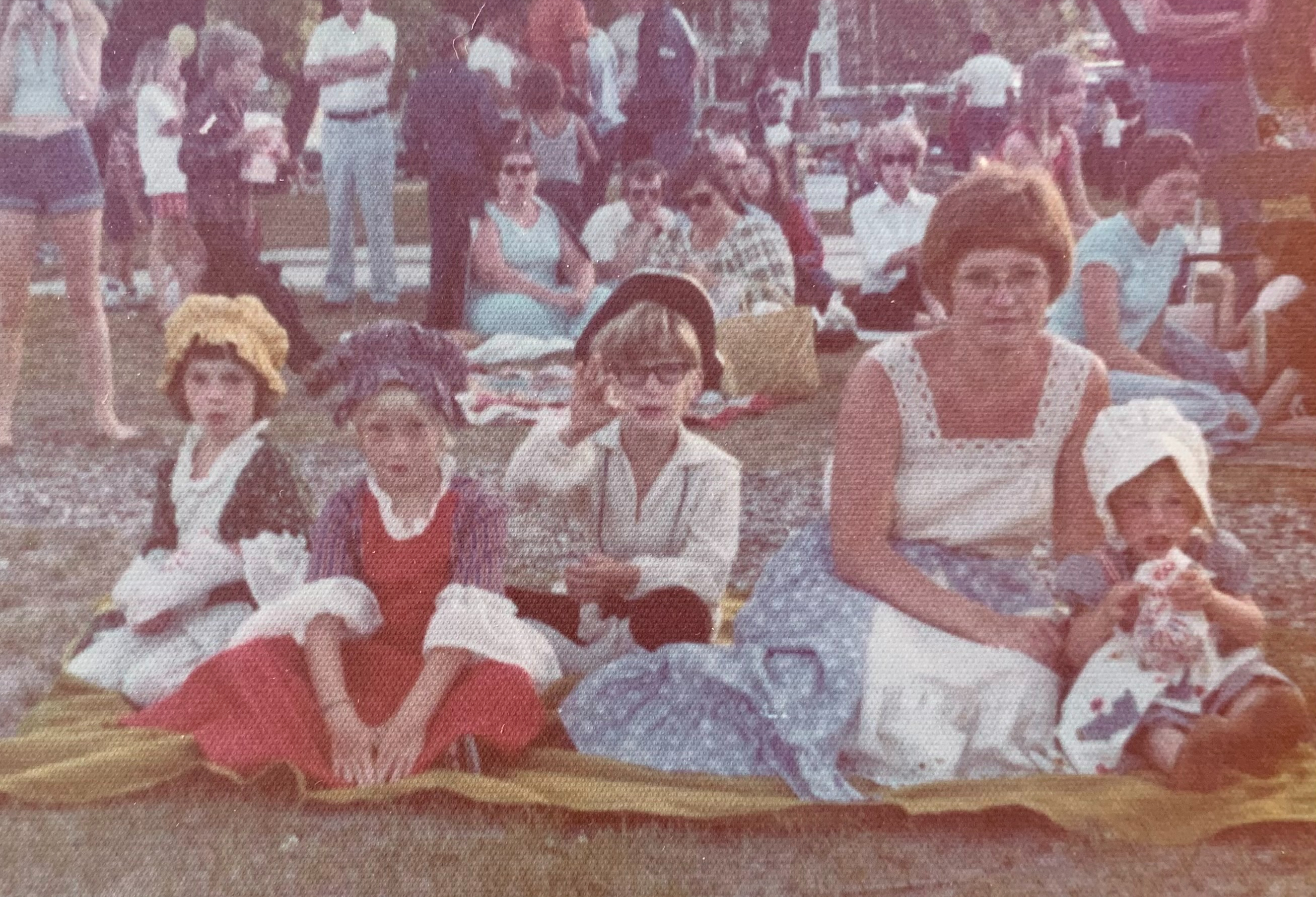
My mother made these colonial outfits for the 1976 Bicentennial parade.
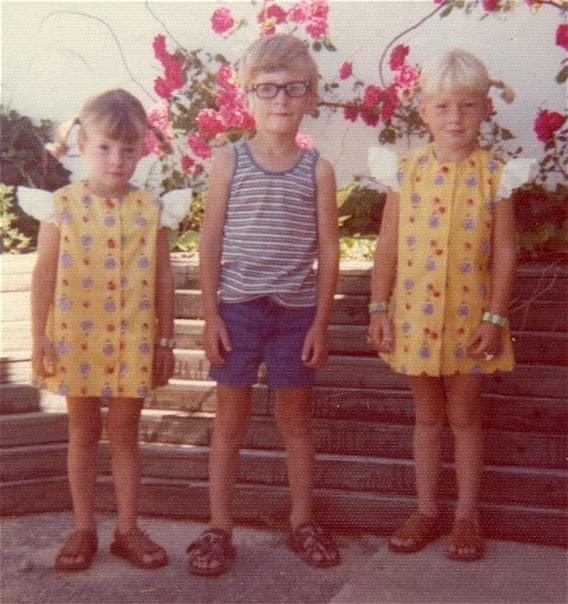
Matching dresses with red apple buttons made by my mom.
First day of school with matching outfits sewn by my mother.
More matching outfits made by my mom.

Nowadays, people seem to be getting into this whole “homestead” movement – grow your own, raise your own, make your own. During my childhood, my mom was nailing this way of life. She was a true badass. She was a nurse. She was a gardener. She was a canner. She was a baker. She was a seamstress. And in all these, she was pretty damn amazing. Frankly, she still is. My childhood was filled with husking sweetcorn around a small table with my sibling, filling buckets of rocks from the garden for a quarter, munching on radishes pulled right from the soil, twinning with my sister in handmade clothes and smiling through it all. I was a happy, well-raised kid. Thanks Mom.
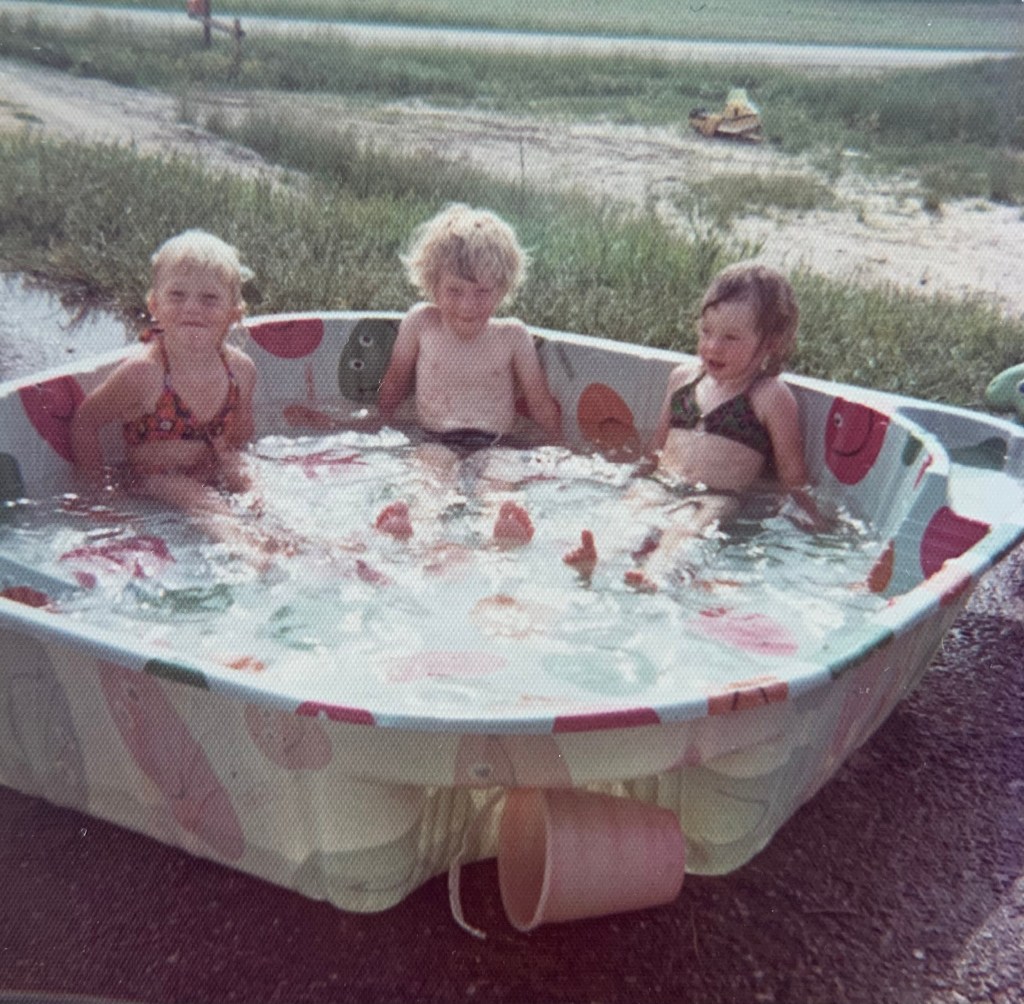
Pool time with my older brother and younger sister.
Summertime sandwiches and Dixie cups filled with Kool-Aid.
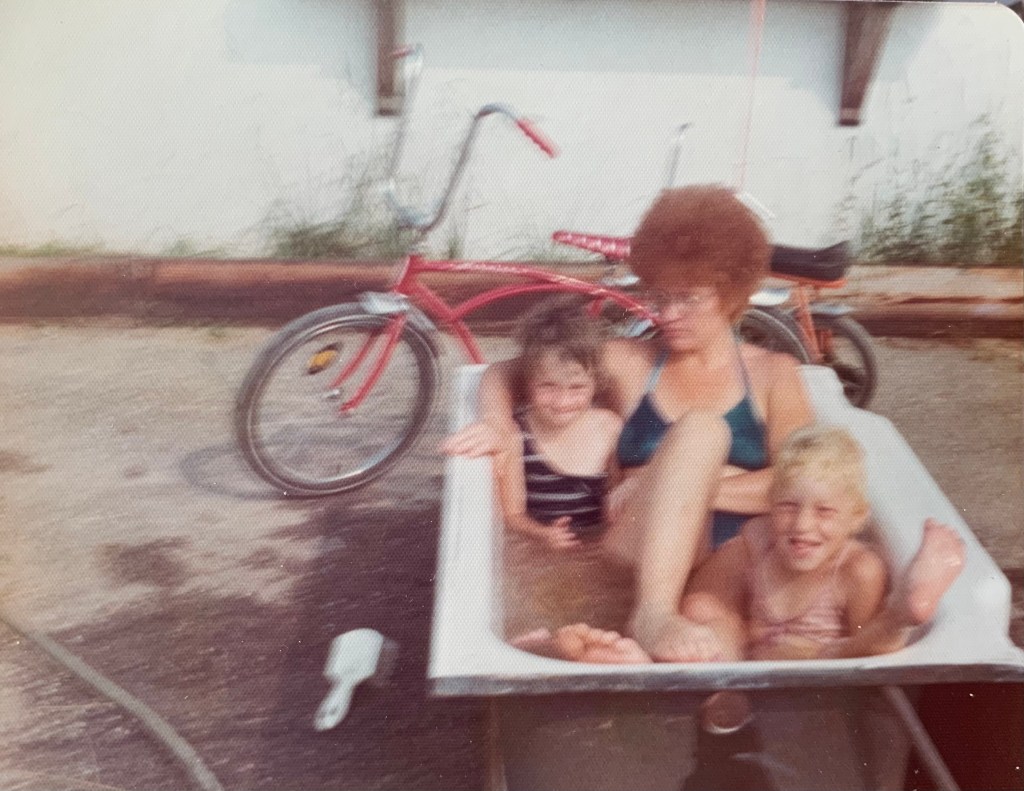
Blurry but a moment of clear happiness in an old tub in the driveway with my mom and sister.

The Egg Lady

Just the other day as I was cresting the hill on the road near my childhood home, the Egg Lady popped into my head. I haven’t thought about her in years. Egg Lady? Who is the Egg Lady, right? The Egg Lady for me is a sweet and carefree childhood memory.

Many years ago, before the dinosaurs roamed the Earth, I was a child. I was a country child with a home nestled in the middle of cherry orchards on the lakeside and cornfields on the other. I enjoyed being a country kid. I was raised on fresh garden vegetables and farm raised chicken eggs.

Just up the hill from our house lived the Egg Lady in a white, two-story farmhouse that stood proudly among the red cowshed, piggery, and coop. Every Saturday, my mother would need more fresh eggs. Situated on the kitchen shelves built by my father, sat four empty, plastic peanut butter buckets. Yes, they were buckets. If an empty egg carton was cut in half, the two halves could fit perfectly inside a bucket. Safe. Protected. These buckets labeled “Peanut Butter” were the protective vessels that I, along with my brother and two sisters, would grab as we headed out to the Egg Lady’s house.

Promptly after a summer morning of Saturday cartoons, we would each grab a bucket, dash to the garage and hop on our bikes. My bike was a purple Schwinn with a white banana seat and high handlebars. It was a sweet ride. With buckets dangling from our handlebars, we would ride down our dirt driveway as the gravel crunched under our tires. At the end of our driveway, we would turn left onto the paved, country road toward the Egg Lady’s house. Off to our right was a forever view of Lake Michigan with cornfields and fruit orchards sharing the same space of beauty. The four of us would pedal and pant as we climbed the gradual hill to the Egg Lady’s farm. Wind whipped. Chains creaked. Seats squeaked. The glorious sounds of riding our bicycles along the country road. We never complained about having to make this ride.

After riding our bikes a quarter mile down the road, we arrived at the Egg Lady’s house. Without hesitation, one of us would jump off our bike and knock on the farmhouse door. Moments later, the Egg Lady would appear. She was a tiny lady with round glasses and short, permed hair. Brown farm boots, jeans, and a worn flannel was the only attire I knew her to wear. She would greet us and lead us into the kitchen that seemed to always smell of freshly, baked bread or pie. The wood floors creaked as we went to the back pantry to fetch the eggs. We would exchange our empty egg carton halves for full ones. Sometimes we would watch as she candled each egg under a bright beam of light. Each egg would light up clear and translucent like a light bulb. This simple and silent process of candling captivated my siblings and me. We waited patiently and with awe to see if our eggs were without chicks. Finally, she would gently pack our egg cartons into the peanut butter buckets then snap on each lid. Leading us past the baked bread and pies, she bid us farewell as the screen door snapped shut behind us.

With our precious cargo dangling from our handlebars, we waved goodbye to the Egg Lady and headed home. The ride home was slower and yet easier as we coasted downhill back to our driveway that again crackled with gravel under our tires. Four dozen eggs would be delivered to my mother from the Egg Lady’s farm. The Egg Lady. A lifetime when all that mattered was getting a peanut butter bucket full of eggs safely home to mother.

Don’t Call It a Farm Unless You Can Do The Hard Stuff

Photo credit: Jessie Zevalkink of JZ Photo.

Last spring during the shutdown, I decided to incubate some of the fertilized eggs from my hens. I have had between twenty to sixty hens at a time over the years. Predators, old age, and illnesses have caused this fluctuation in numbers and is expected when you decide to raise chickens. My first seven hens had names: Opal, Ethel Mae, Bertha, Bessie, Petunia, Violet, and Zinnia. I even made a sign that displayed their names and I hung it on the side of their coop. After a couple deaths in my flock, I stopped naming my hens. I’ll admit that losing my first hen was hard. She was a gorgeous Ameraucana chicken named Zinnia. So last spring with my hen numbers down, I decided to see if I could successfully incubate eggs from my hens. I had three Buckeye roosters and a wide range of hen breeds. What hatched from each egg was going to be a delightful surprise. 

Photo credit: Jessie Zevalkink of JZ Photo.

I diligently gathered twenty-two eggs of a variety of colors: olive green, light blue, cream, light pink, light brown, dark brown, and speckled brown. With an incubator filled with a colorful collection of eggs fit for an Easter basket, I began the incubation process. Generally, you can expect 75-90% of the eggs to hatch successfully. (If you order eggs to hatch, that percentage decreases to as low as a 50% success rate.) After 21 days, all of the eggs hatched. Every. Single. One. Of course, I had no idea how many were going to be hens and how many would be roosters. I was aware that by incubating my own that I would definitely get some roosters. The probability of hatching hens versus roosters is about 50/50 with a slight lean toward having more roosters. All the chicks from the incubation survived except one. It was tiny and had a difficult time pecking its way out of the shell. 

Over time, the chickens got bigger and I began noticing large plumes of tail feathers  emerging on a number of them – as in eight of them. I already had three roosters. So this brought my count to eleven roosters. There were about 40 hens in the flock so this was going to be a problem. Ideally, you want one rooster for every 10 -12 hens. Having too many roosters can take a heavy toll on hens. As the roosters grew in size and as their interest in the hens grew, I quickly observed the negative effect on the hens. First of all, they rarely had a break from the relentless mounting of the roosters. One hen would get pinned down. Once released, another rooster would pin her down. And then another after that. Often I would find all of my roosters chasing one, clearly exhausted, hen around the coop. It was too much for any hen. The hardship on my hens needed to stop. They had bald spots and missing feathers. Their egg production was down and they started hiding under the coop most of the day. My hens were overworked. I needed to bring back harmony and balance to my flock. My hens deserved better. It became clear that I needed to harvest some roosters for the health and happiness of my hens. 

I couldn’t harvest the roosters straight away. They needed some time to mature and bulk up a bit. I also had to come to terms with what it meant to harvest them – putting an end to their life. I had never done it before and I was doubtful about my ability to do it. In the meantime, I made sure my roosters were well fed and well cared for during their time on the farm. 

Harvesting day arrived. I had to make the selection of who survived and who was sacrificed for the good of all. My rooster count needed to decrease to four which meant 7 had to go. I decided on my oldest three roosters, one rooster who was showing signs of aggression, and three large young roosters all of the same breed. Prior to the day, a dear friend of the family – Matt – volunteered to show my husband, Sander, and me how to harvest a chicken. It was brutal to watch at first but he showed us how to end the rooster’s life with compassion. He patiently guided us through each step as he methodically harvested the first bird on our farm. It felt a tad ceremonial. The second bird was harvested by my husband as Matt reviewed each stage of the process with him while peppering in helpful tidbits. The conditions outside, however, were not ideal. It was getting dark and the temperature was dropping to the low 30s. Thankfully there was a bonfire nearby so we had opportunities to warm our hands as needed. With the knowledge that Matt shared with us, we felt ready to harvest the remaining five birds the following day. The weather would be warmer and it would be daytime. 

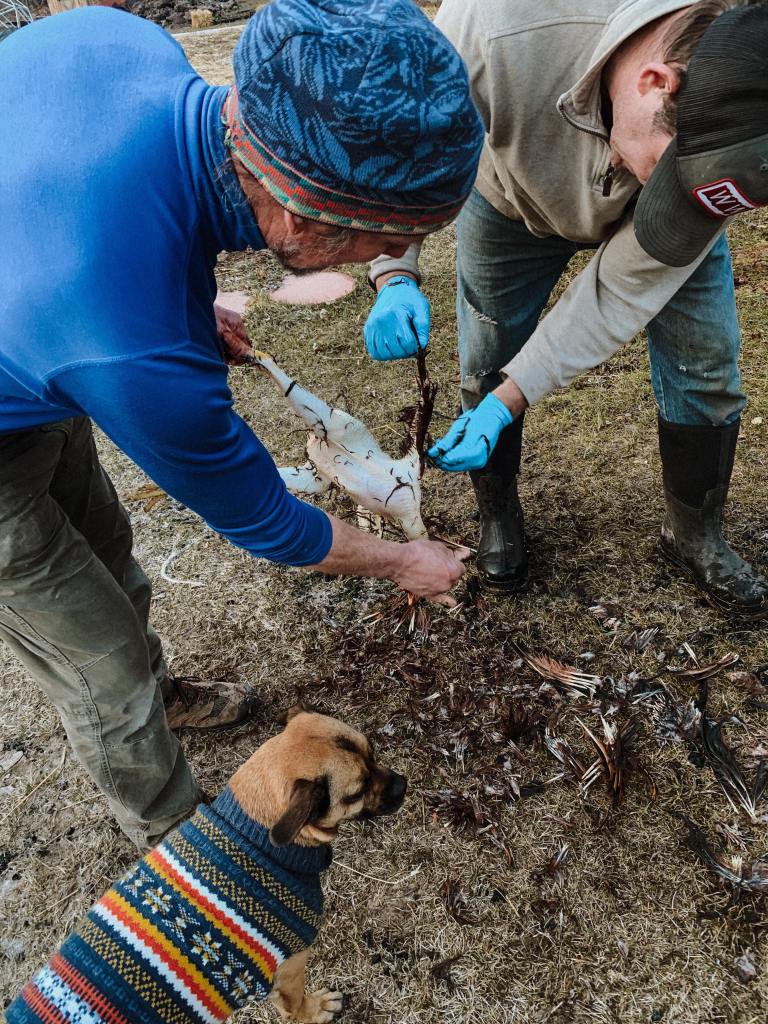
Matt showing us how to pluck the feathers off the bird after scalding it for about 20 seconds in hot water. Miggie, the farm’s security dog, looks on as he sports his “off duty” sweater.

With the sun overhead and already warming up the day, my husband and I got an early start. The kill cones (yes, such an awful name) were discretely hung out of sight of the flock as well as any visitors to the farm. The five chosen roosters were captured and separated from the rest. Killing the birds was emotional for me. However, it was necessary. These harvested birds were going to provide meat for my husband and me. Meat from birds we cared for and raised. The slaughtering stage is not for the faint of heart. It needs to be done as humanely and compassionately as possible. We consoled and thanked each bird as we watched the blood drain from them into the buckets below. Not a glamorous task. There is blood and blood splatter. Initially, I was going to let my husband deal with this stage. Yet it didn’t seem right for me to let him bear this burden alone. It was my flock. My roosters. I needed to “put on my big girl pants” and see this through…every difficult step. The killing. The scalding. The plucking. The gutting. The cutting. All of it. So on a sunny, late Saturday morning, my husband and I harvested five roosters. Once I accepted that it could be done with dignity and care, I stood in the sun and quietly honored each bird as I moved through the process. 

Not a cone of shame but a cone of sacrifice.

My roosters were raised seeing sunshine and rain. They weathered cold and snow with a coop to shelter them. They lived a good life. Their sacrificed lives will provide meat for my family and a needed balance back to my flock. The coop is noticeably quieter now. My hens are emerging from their hiding place under the coop. All is well on the farm. Having a farm means you need to be able to not only handle but DO the hard stuff. It’s one thing to raise a few chickens for eggs and a whole other thing to actually harvest the chickens.

The hard stuff.

This place I call home is a farm that will continue to evolve. It will continue to evolve me. I can do the hard stuff. I am learning to recognize the lessons in the harder things. The farm is a place that is gifting  me a deeper understanding of farm life and the balance of all things living. My family and I are cultivating plants for food, nurturing chickens for eggs, tapping trees for sap, housing bees for honey, raising pigs for pork AND the hard stuff – harvesting roosters for meat. Honoring every stage of life on our farm is and will be the key to its success and the balance that keeps it flourishing with every season. 

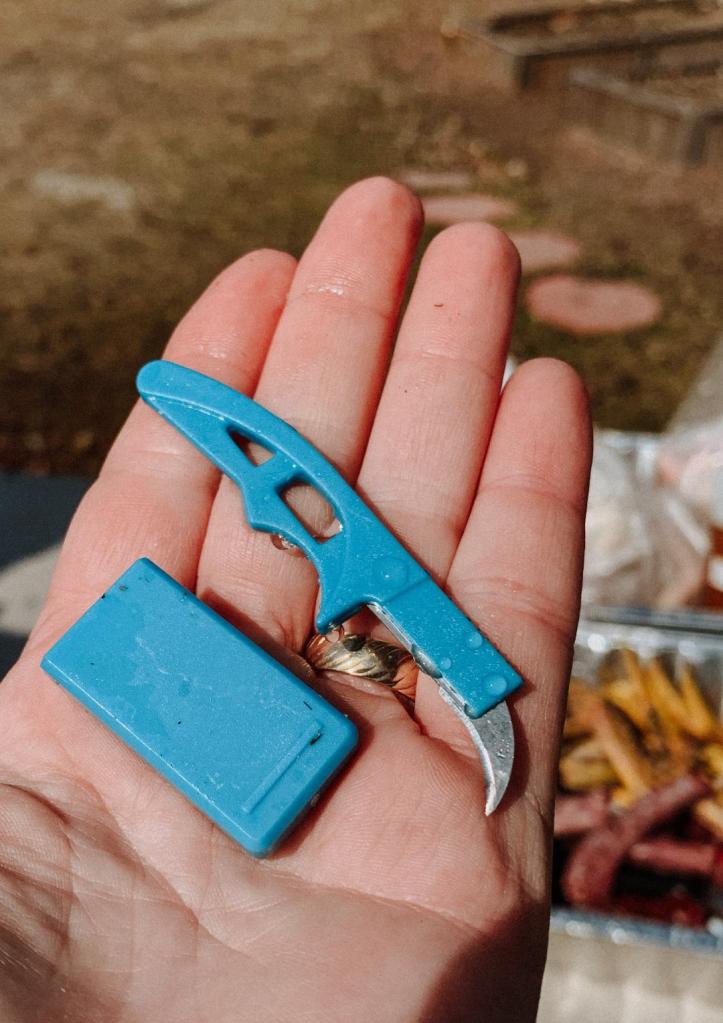
This cheap and handy tool proved to be an asset. I discovered my unknown ability to cut around the bird’s anus with precision without rupturing the bowel. I am now a “near expert” at butthole and bowel removal. Surprising, huh? If you are harvesting a bird, get this handy little tool.
Moments after the most difficult stage in harvesting the birds, I found this heart shaped rock embedded in the ground just a few feet away from the table in which we were going to continue the process. It reminded me to do all things with love and care.
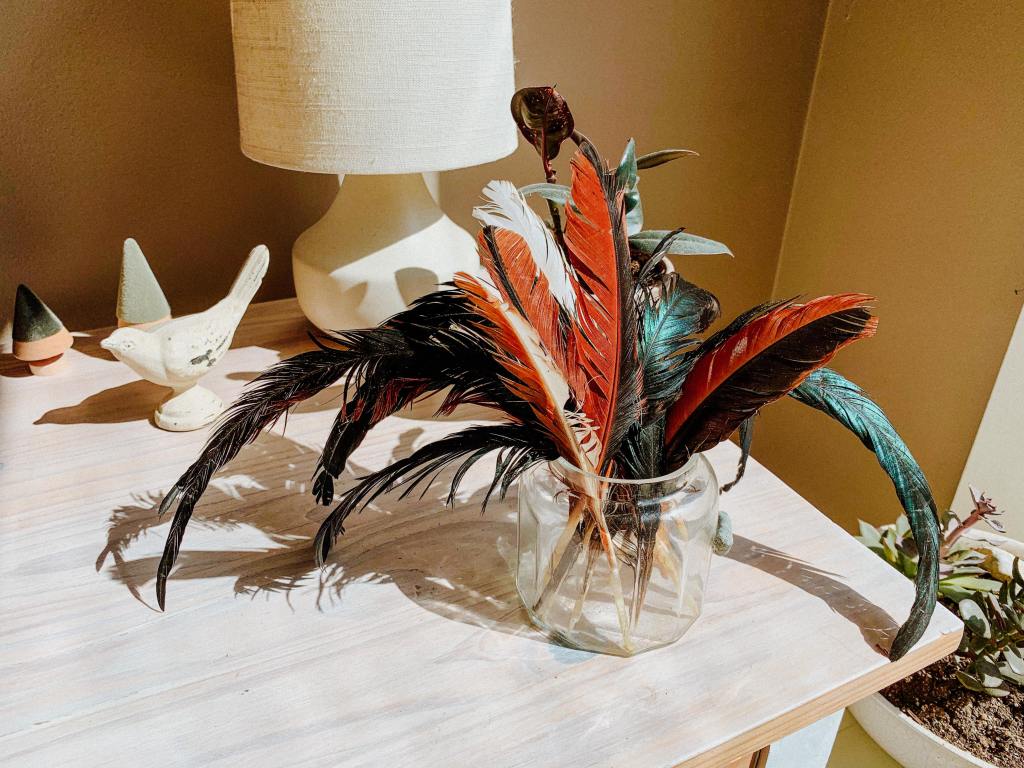
A collection of feathers I gathered after harvesting the roosters. They are a simple reminder of the majestic roosters that resided on our farm and through their gift of meat will nourish us in the future.

What Begins With “RE-“?

It’s not a trick question. There are numerous words that begin with the letters ‘RE’. Since moving back to our up north farm there are a few of these words that resonate with me. Reconnect. Rediscover. Reflect. Renew.

Reconnect. In the late 1990s, we purchased this 12-acre farm located in a valley from my grandfather who I called Grandpa Jack. This plot of land holds many childhood memories for me. When we had the opportunity to buy the farm, my husband and I jumped at the chance. We had recently built a home just outside of Leland at the time. Without much hesitation, we put the Leland house on the market along with the vacant lot next to it. The farm would offer us so much more than our town house would. The farm had a barn with four horse stalls. It had fruit trees. There was a fresh water spring that fed a creek that diagonally cut across the property. It was surrounded by a wooded area that various species of trees populated. Above the valley where the house and barn sat, was a steep hill that overlooked the property and Lake Michigan. But the best part was that the property had memories. My childhood memories. It was my desire to reconnect with this sacred land so it could begin to create memories for my own children. Now, I have returned again to reconnect and continue adding to my memory bank.

Rediscover. Being back at the farm has allowed me to rediscover why I have loved this property so passionately. This rediscovering has been facilitated by my daughter – Isa – who is studying permaculture. Through her knowledge and guidance, I am discovering the ever present potential of the farm. She is showing me how we can provide for the land and honor what it has to offer. I am excited to work alongside her as she plans and teaches me how to truly value the beautiful gifts of nature that this farm if giving us.

Reflect. When we first moved to the property, we seemed to be on overdrive. Things were done quickly and with short-term goals in mind. However, this return is allowing for reflection – a more thoughtful, longterm approach to how we envision the property. This will be our last move. (This was our 12th move and we aren’t even a military family.) This will be our retirement home. This will be the space that my children inherit. This reflection includes walks around the property, residing in the house, discussions with my family, and observations of plant growths.

Renew. Being on the property, I feel renewed. I made it back and now I can submerse myself in projects on the property. I can renew my creative spirit. I can renew my love of the property. I can renew the life I once had.

I am home.

The Big Chicken Move

Chickens. Yes, I have them. I have many of them. I started with my seven original girls of which only three are left. But my flock has grown from there… a lot. 

Selling our house meant moving all the chickens. Mind you, it was more than seven chickens that needed to be moved. Before relocating them, we had to build a run for them and move their coops. Then we could move them. 

With location input from my daughter, Isa, we decided to place the new run on the northeast corner of our property. The area was formerly a part of the original paddock that my grandfather installed for his horses. The wooden posts have since been weathered and many have been removed. We have used much of the old fence planks for renovations we have done on the apartment and the main house. 

I wanted a large run area because I have well over fifty chickens – yes, you read that correctly. There will likely be more because I plan to let one of my broody hens sit on eggs this spring. Having a large run meant digging many post holes. We used 8-foot tall, treated fence posts. My husband dug holes and set posts for the first half of the run. The holes were dug down two feet deep as I wanted the fence to be 6 feet high. I dug the remaining holes. Then with the help of my husband, I set the posts for the final half of the run. “What is it, the first hole I dug? I’ll **cking dig a hole. Where are the shovels?” 

We decided to install two gates – a small one for daily use and a large one for vehicle entrance when needed. The small gate was built by my son, Sawyer. On it is a sign that reads, “Keep gate closed no matter what the chickens say.” My mother gifted it to me. Trust me, my hens will try to convince you to open the gate for them. 

Once the fence posts were erected, I spent a total of three evenings – on my own – installing the wire fence around the run. I had done it before at our other house. It is important to leave about a foot of fencing at the base and to bury it. This helps with critter control and escapees. The rolls of wire fencing are heavy and by the 2nd night I finally developed a strategy of rolling the fencing out on the ground the length of the fence side I was working on. Then I would prop up the roll at the end against the corner post. From there I lifted and temporarily attached the fencing about every third post. Inclines are tricky when you are installing a fence. Not impossible, but definitely tricky. 

After the wire fencing was installed, my husband and I spent an afternoon putting in the small gate. He had already installed the large gate when he had set the first round of posts. Now we were ready for the coops. Trust me, moving coops is not easy and takes coordination, manpower and big equipment. We had two coops that we needed to relocate to the new chicken sanctuary. 

My husband coordinated the entire move. He enlisted the help of two local farmers – one to help load the coops and one to help unload. I have found that local farmers are some of the most helpful and knowledgeable people. This task would have been near impossible without their help and guidance. Our local farmers are an asset to our community and I am deeply grateful for the assistance of these two local farmers during the move. 

Secured coops at the new location meant we were ready for chickens. It was time for the big move of nearly sixty chickens. How does one move that many chickens? It takes some planning. The night before the move, I made sure all my hens were secure inside a coop. Some of my girls would perch in the partially enclosed feed storage area. But that night, I put them inside a coop. The next day, I kept them inside the coops and did not let them out at all. They needed to stay inside until we were ready to move them. It rained all day. 

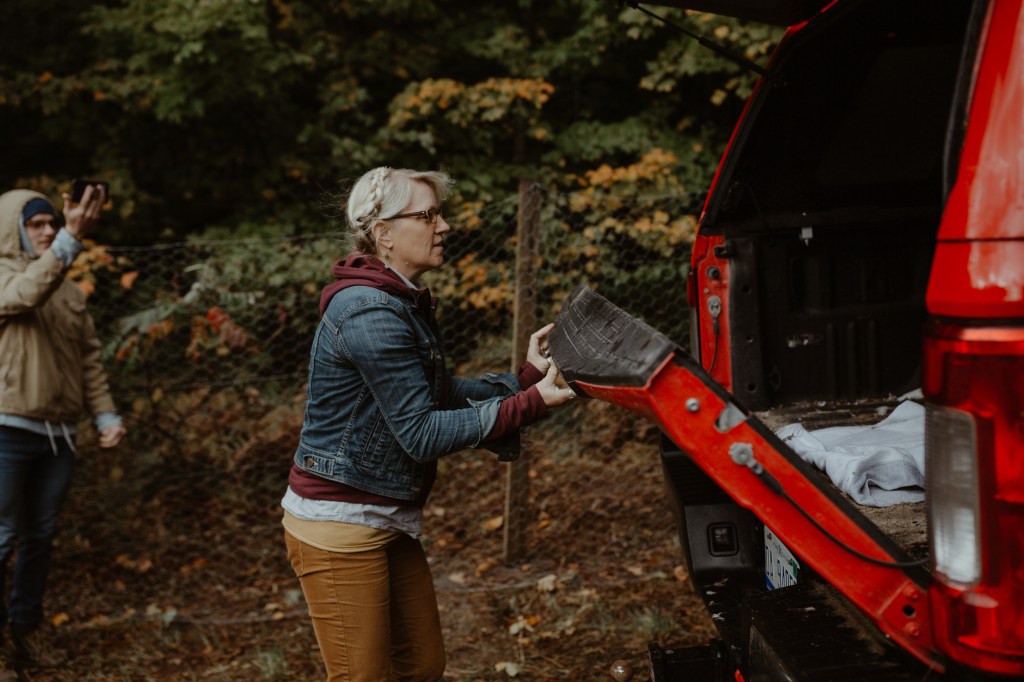
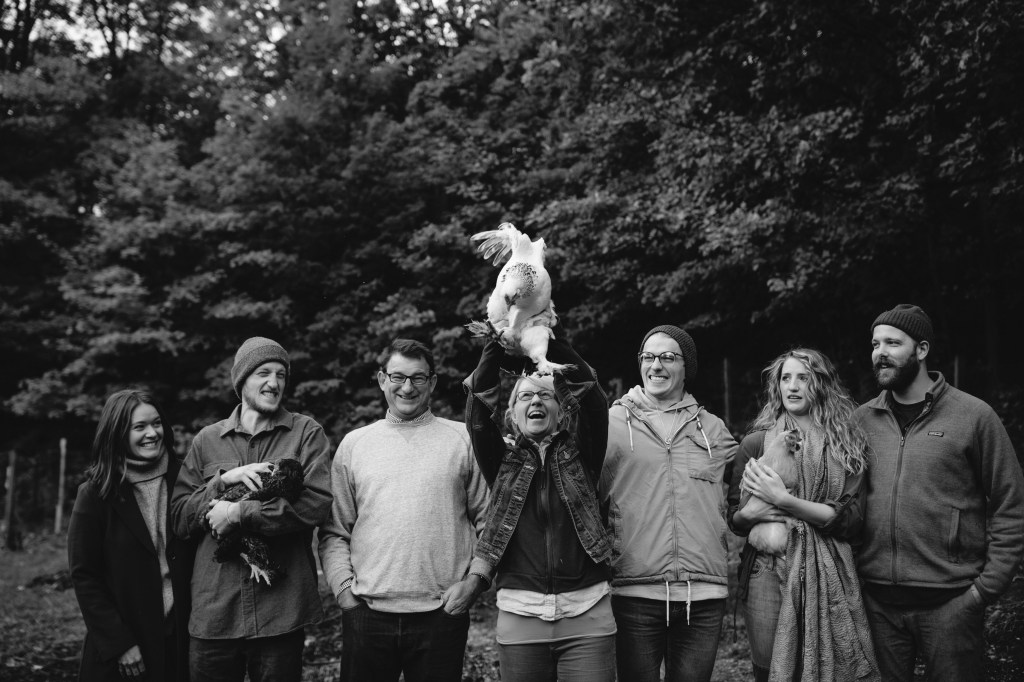
In addition to moving the chickens, we had family photos scheduled at the farm. The photographer, Jessie Zevalkink, is a documentary style photographer. I thought it would be fitting for her to not only photograph my family but to also visually document the chicken move. Therefore, we had to time the arrival of the chickens to the arrival of the photographer. 

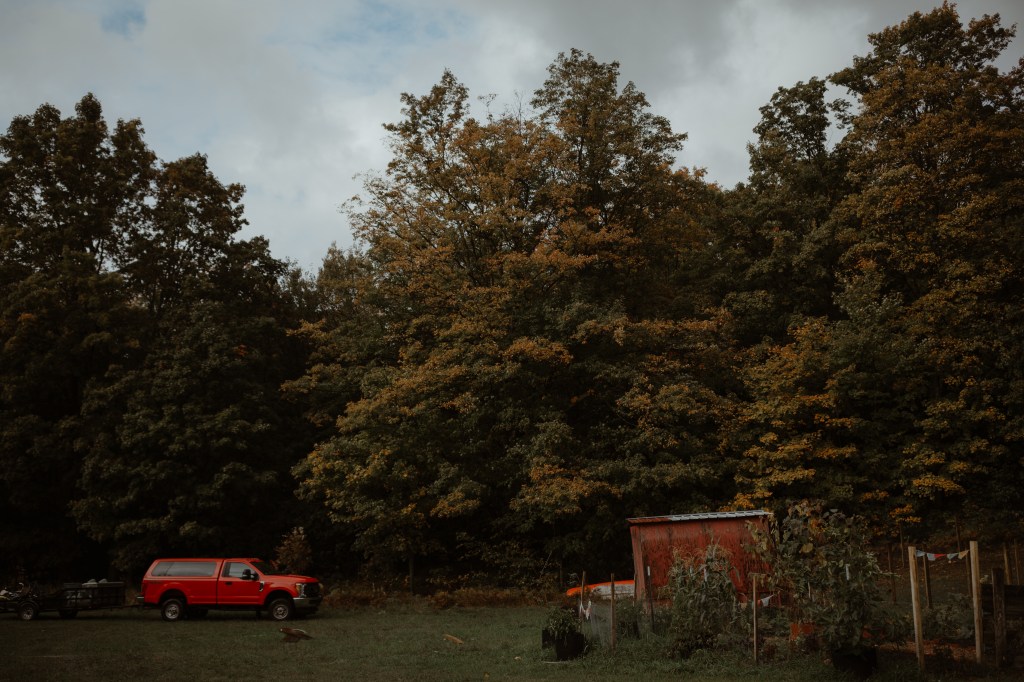
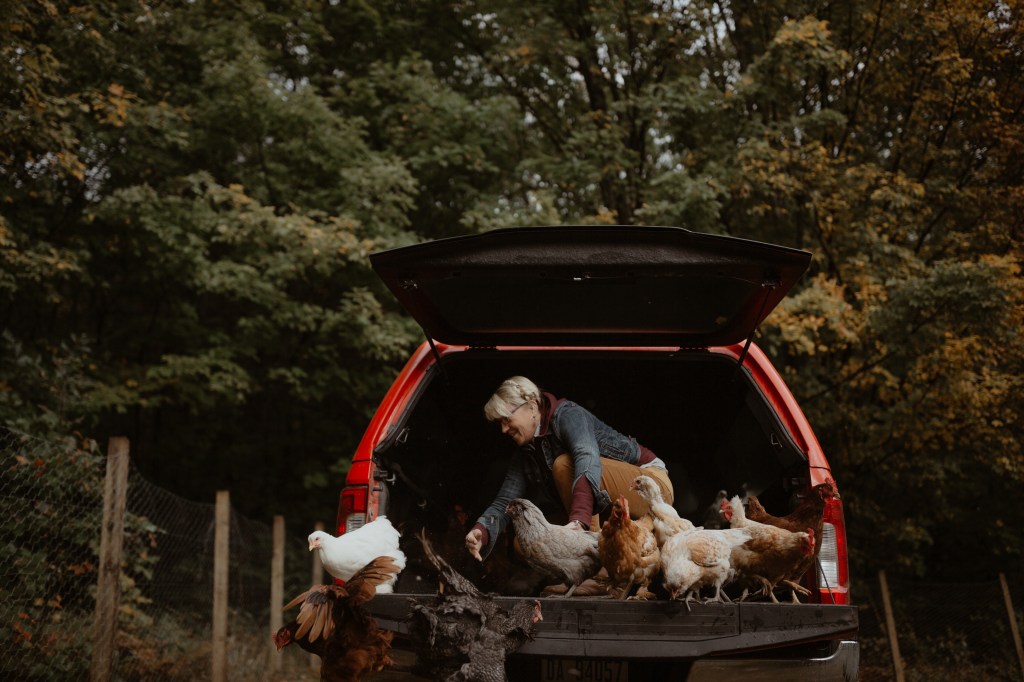
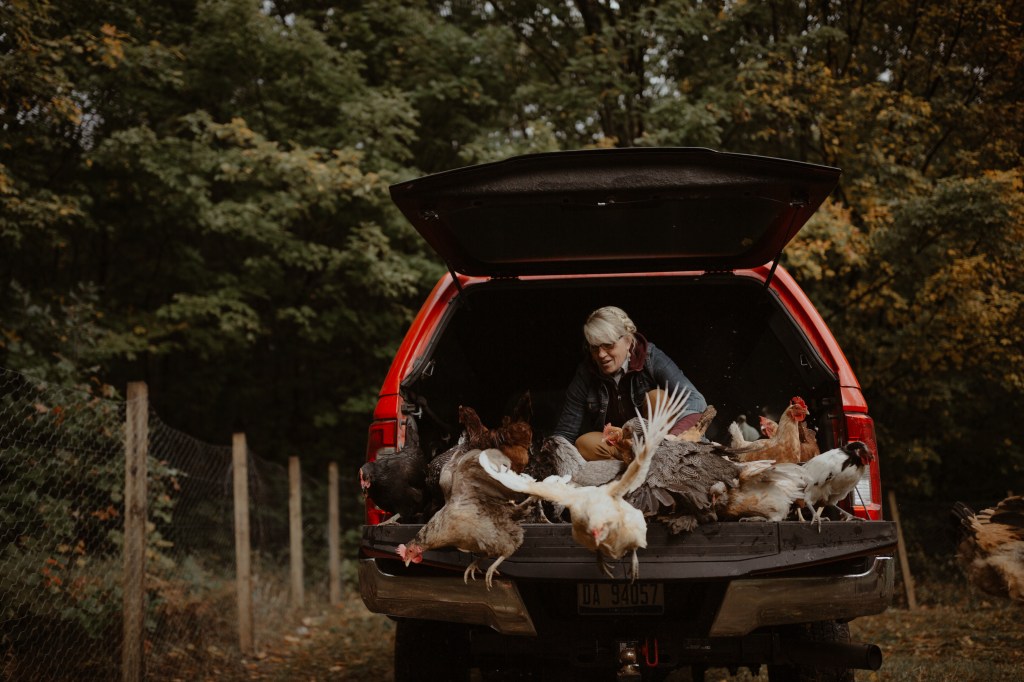
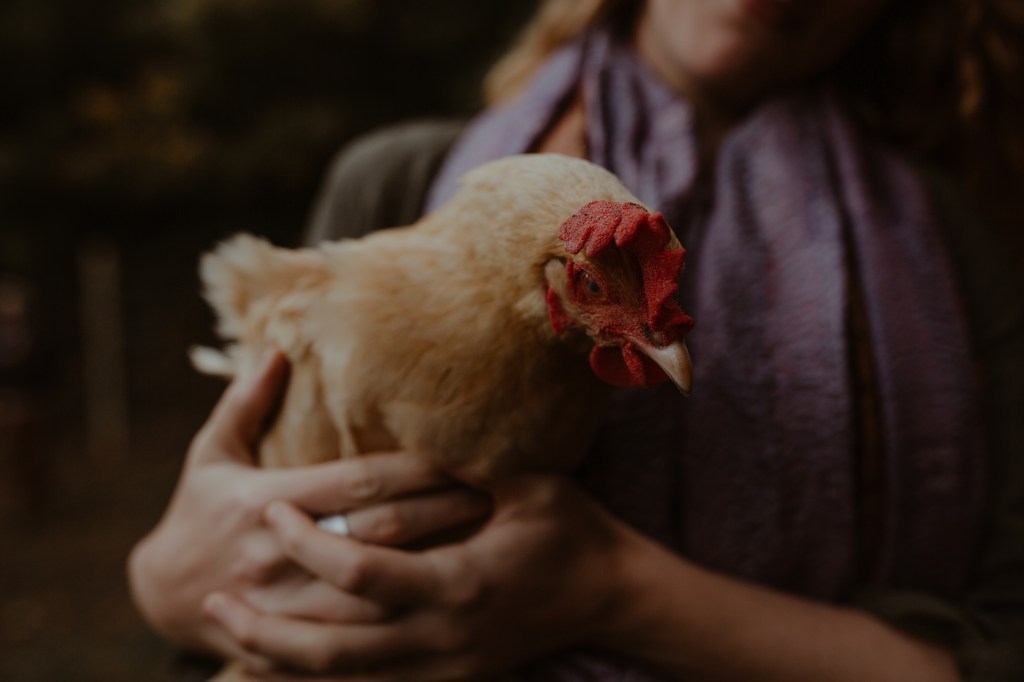
Luckily, the rain let up and around 3:30p that day we began to load the hens into the back end of my husband’s F-350 Ford truck. One-by-one and sometimes four hens at a time – I am a master at holding multiple chickens at once – we loaded them into the truck. A few screeching squawks, a few flying feathers, and a few pitiful pecks later, we had all sixty-some hens loaded into the truck. 

I joined the hens. I wanted to make sure they were safe and calm for the transport. The trip was slow and steady with my husband navigating every turn and bump carefully. When we finally arrived at the farm, the photographer was there waiting. Perfect timing. In addition, the rain had subsided and the radar on my phone indicated we had a window of about an hour before the rain returned. It was “go time”. 

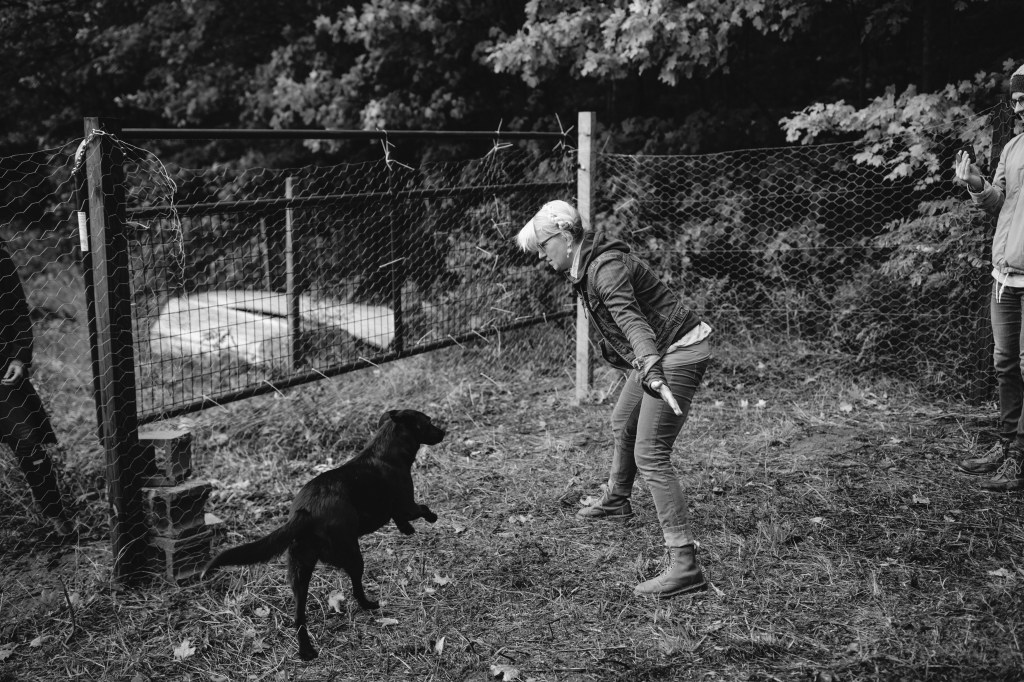
Armed with her camera, Jessie was ready to capture the release of my hens from the truck. My husband opened the tailgate of the truck as I waited inside with my girls. Surprisingly, once the gate was open my hens made no effort to leave the back of the truck. With my arms flapping and some herding, the hens began to hop and fly out of the truck. Finally, they were inside their new run area. They were a bit frantic at first but quickly calmed down and settled into scratching and exploring. They were happy. I was happy. Mission accomplished. 

When my husband had first indicated to me that he wanted to sell our Maple City house, the first thing I thought of was “what about my chickens?” It was a daunting task to move them but worth it. My husband knew that to ease the anxiety that sometimes comes with moving, that I would need to have my chickens. My hens are currently settled into their new home. My daughter, Isa, has helped to take care of them during the transition. The hens’ eggs will go nicely with her farm market during the next harvest. So it is official – the Happy Hens Homestead has been relocated to our family farm located in Northern Michigan. Happy hens, happy me.

(Sidenote: All photographs were done by the talented, Jessie Zevalkink of J.Kevalkink Photography. She’s an adventurer and has sailed the Atlantic Ocean along with her husband.)

The House That Jack Built

The essential joy of being with horses is that it brings us in contact with the rare elements of grace, beauty, spirit, and freedom.” ~ Sharon Ralls Lemon

During the early 70s my grandfather, H. Jack Brown, and my grandmother, Roberta, purchased the 12 acre plot. They moved from West Virginia to retire in Michigan. My grandfather raised quarter horses (along with my Aunt Larri) and brought three with him from West Virginia. The horses wer Blair Cody Miss – “Missy”, Daylight Dancing – “Joey”, and Golden Gain – “GG”. Therefore, the first structure he built on the property was a barn with four horse stalls that could withstand a hurricane. While the barn building took place, he and my grandmother lived in a camper. On the side of the barn, opposite of the stalls, he built an apartment. It was a one bedroom apartment with a loft and an open floor plan for the kitchen and living room. It was tiny but functional. Later he added a sunroom which added light and space to the apartment.

After the apartment was complete, he built the main house. It was completed in 1983. It was a ranch style home. He did the stonework for the fireplace and the front entrance by himself using rocks from the property. There are a few rock with “fool’s gold” embedded in them. If you look carefully, you can find them. I remember when the walls were set for the basement, my siblings would climb up and move along the perimeter of the top of the concrete block walls. I couldn’t, even though I tried, because I was terribly afraid of heights.

For the horses, he erected a large paddock that had a fresh water stream running through it. Large willow trees lined the roadside of it. Nestled in a valley, it was the perfect home for the horses.

In 1998, my husband and I had the opportunity to purchase the property. We jumped at the chance. We sold our home that we had recently built in Leland and the vacant lot we owned adjacent to the home. My grandfather’s property was perfect for raising a family – it had a creek, lots of land, fruit trees, and plenty of space for play. Eventually, I would fill the stalls again with horses. I had two Egyptian Arabian horses – Razine and Tairza. I also had two quarter horses – Jack and Norman. I miss raising horses and the smell of a horse barn brings a flood of sweet memories and a deep longing for horses.

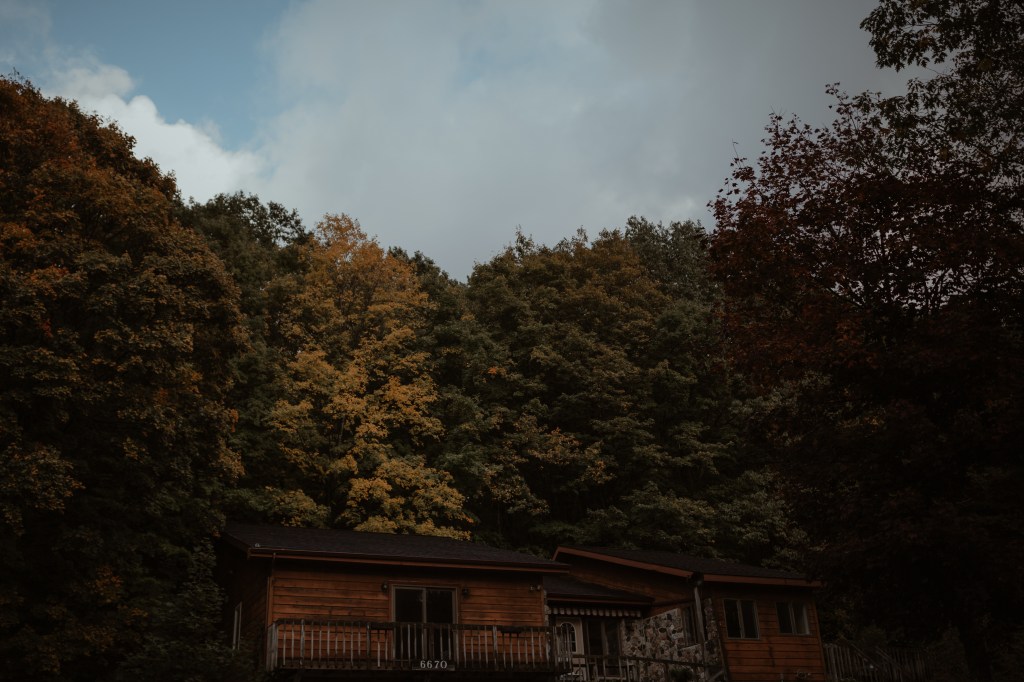
Eventually, we moved due to my husband’s job. During that time, we had many renters stay in the home. But we are finally returning home. Returning to the home my Grandpa Jack built – the house that Jack built.

Hello Friend

PC: Jessie Zevalkink

Hello, I’m Shannon – a wife to my high school sweetheart, a mother to three adult children, and a pet owner of many chickens and two doodles.

I decided to start a blog to journal things happening on our Northern Michigan farm that we purchased in the mid ’90s from my Grandpa Jack. We have left that farm for many years and are finally returning to our roots – to the land that is our family connection. I have many wonderful and lingering memories of my childhood and my children’s childhood submersed into the history of that property. It has been the place we have always considered our “true home”.

There are BIG plans for the property. My daughter will be doing gardening and land care projects. My sons will be helping with the renovation of the main house. I hope to have workshops with my daughter, dinners under the willows, bonfires with friends, and so much more. I hope to share all of this with you as way of documenting the life that emerges and evolves on the property we call Willow Glen Farm.