
Last spring during the shutdown, I decided to incubate some of the fertilized eggs from my hens. I have had between twenty to sixty hens at a time over the years. Predators, old age, and illnesses have caused this fluctuation in numbers and is expected when you decide to raise chickens. My first seven hens had names: Opal, Ethel Mae, Bertha, Bessie, Petunia, Violet, and Zinnia. I even made a sign that displayed their names and I hung it on the side of their coop. After a couple deaths in my flock, I stopped naming my hens. I’ll admit that losing my first hen was hard. She was a gorgeous Ameraucana chicken named Zinnia. So last spring with my hen numbers down, I decided to see if I could successfully incubate eggs from my hens. I had three Buckeye roosters and a wide range of hen breeds. What hatched from each egg was going to be a delightful surprise.

I diligently gathered twenty-two eggs of a variety of colors: olive green, light blue, cream, light pink, light brown, dark brown, and speckled brown. With an incubator filled with a colorful collection of eggs fit for an Easter basket, I began the incubation process. Generally, you can expect 75-90% of the eggs to hatch successfully. (If you order eggs to hatch, that percentage decreases to as low as a 50% success rate.) After 21 days, all of the eggs hatched. Every. Single. One. Of course, I had no idea how many were going to be hens and how many would be roosters. I was aware that by incubating my own that I would definitely get some roosters. The probability of hatching hens versus roosters is about 50/50 with a slight lean toward having more roosters. All the chicks from the incubation survived except one. It was tiny and had a difficult time pecking its way out of the shell.
Over time, the chickens got bigger and I began noticing large plumes of tail feathers emerging on a number of them – as in eight of them. I already had three roosters. So this brought my count to eleven roosters. There were about 40 hens in the flock so this was going to be a problem. Ideally, you want one rooster for every 10 -12 hens. Having too many roosters can take a heavy toll on hens. As the roosters grew in size and as their interest in the hens grew, I quickly observed the negative effect on the hens. First of all, they rarely had a break from the relentless mounting of the roosters. One hen would get pinned down. Once released, another rooster would pin her down. And then another after that. Often I would find all of my roosters chasing one, clearly exhausted, hen around the coop. It was too much for any hen. The hardship on my hens needed to stop. They had bald spots and missing feathers. Their egg production was down and they started hiding under the coop most of the day. My hens were overworked. I needed to bring back harmony and balance to my flock. My hens deserved better. It became clear that I needed to harvest some roosters for the health and happiness of my hens.
I couldn’t harvest the roosters straight away. They needed some time to mature and bulk up a bit. I also had to come to terms with what it meant to harvest them – putting an end to their life. I had never done it before and I was doubtful about my ability to do it. In the meantime, I made sure my roosters were well fed and well cared for during their time on the farm.
Harvesting day arrived. I had to make the selection of who survived and who was sacrificed for the good of all. My rooster count needed to decrease to four which meant 7 had to go. I decided on my oldest three roosters, one rooster who was showing signs of aggression, and three large young roosters all of the same breed. Prior to the day, a dear friend of the family – Matt – volunteered to show my husband, Sander, and me how to harvest a chicken. It was brutal to watch at first but he showed us how to end the rooster’s life with compassion. He patiently guided us through each step as he methodically harvested the first bird on our farm. It felt a tad ceremonial. The second bird was harvested by my husband as Matt reviewed each stage of the process with him while peppering in helpful tidbits. The conditions outside, however, were not ideal. It was getting dark and the temperature was dropping to the low 30s. Thankfully there was a bonfire nearby so we had opportunities to warm our hands as needed. With the knowledge that Matt shared with us, we felt ready to harvest the remaining five birds the following day. The weather would be warmer and it would be daytime.
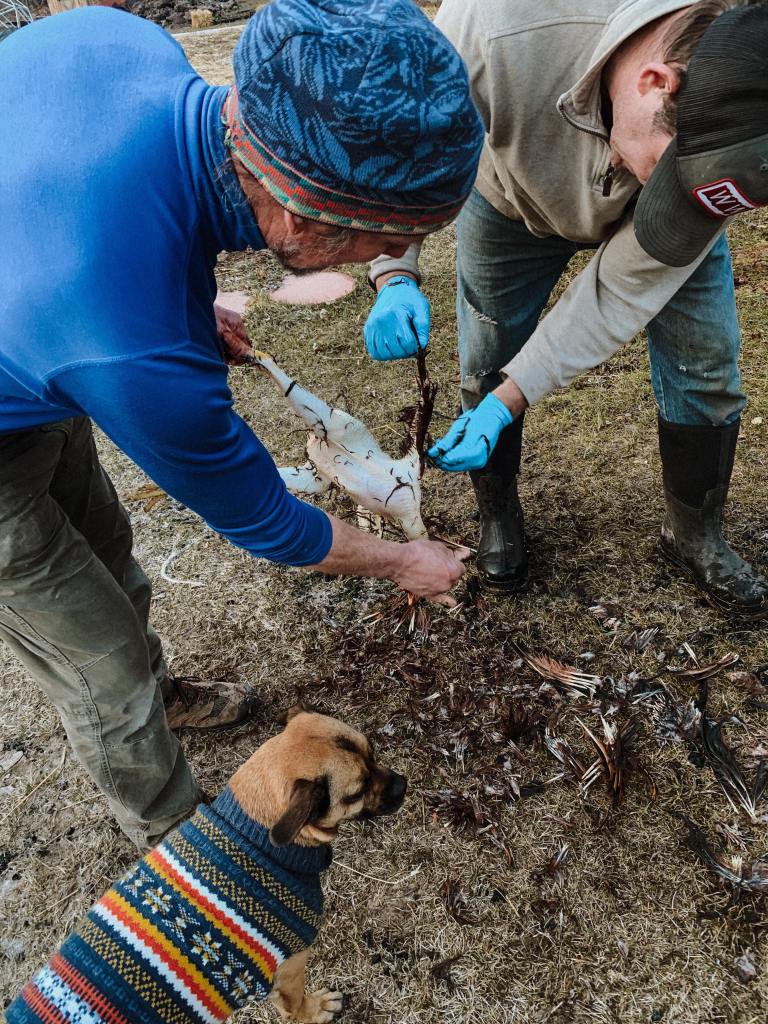
With the sun overhead and already warming up the day, my husband and I got an early start. The kill cones (yes, such an awful name) were discretely hung out of sight of the flock as well as any visitors to the farm. The five chosen roosters were captured and separated from the rest. Killing the birds was emotional for me. However, it was necessary. These harvested birds were going to provide meat for my husband and me. Meat from birds we cared for and raised. The slaughtering stage is not for the faint of heart. It needs to be done as humanely and compassionately as possible. We consoled and thanked each bird as we watched the blood drain from them into the buckets below. Not a glamorous task. There is blood and blood splatter. Initially, I was going to let my husband deal with this stage. Yet it didn’t seem right for me to let him bear this burden alone. It was my flock. My roosters. I needed to “put on my big girl pants” and see this through…every difficult step. The killing. The scalding. The plucking. The gutting. The cutting. All of it. So on a sunny, late Saturday morning, my husband and I harvested five roosters. Once I accepted that it could be done with dignity and care, I stood in the sun and quietly honored each bird as I moved through the process.

My roosters were raised seeing sunshine and rain. They weathered cold and snow with a coop to shelter them. They lived a good life. Their sacrificed lives will provide meat for my family and a needed balance back to my flock. The coop is noticeably quieter now. My hens are emerging from their hiding place under the coop. All is well on the farm. Having a farm means you need to be able to not only handle but DO the hard stuff. It’s one thing to raise a few chickens for eggs and a whole other thing to actually harvest the chickens.

This place I call home is a farm that will continue to evolve. It will continue to evolve me. I can do the hard stuff. I am learning to recognize the lessons in the harder things. The farm is a place that is gifting me a deeper understanding of farm life and the balance of all things living. My family and I are cultivating plants for food, nurturing chickens for eggs, tapping trees for sap, housing bees for honey, raising pigs for pork AND the hard stuff – harvesting roosters for meat. Honoring every stage of life on our farm is and will be the key to its success and the balance that keeps it flourishing with every season.

 Life On Willow Glen Farm